For the past 14 weeks in this course, I have learnt so much from it and got something out of it. In this web blog assignment, I have came to know more about blogging since I have not blog before, in fact this is the first blog I have ever created. Kudos to that. I have learnt on what to do in a blog and what not to do. For example, which colors to use and what font is appropriate for readers that reads a blog.
I have also gain a better understanding of problems faced by document designers through the thorough research of document designs in this course. With this knowledge, I know more about document designs where images and words placement are crucial for readers. Moreover, I have educated myself about copyright and infringement; as to be an ethical blogger and student, I must cite everything I get from someone and give credits to them. I could and will not copy something and do not give credit to the owner of a statement or an image.
Overall, I believe that issues in publication and design have given me a very educational experience especially in this assignment.
Tuesday, 12 June 2012

Copyright, Plagiarism & Fair Use (Pirate Bay)

It is only
fair and just when somebody's work is given a credit even though if a third
party attempts to use it. The inventor should be entitled to be given a credit
as it is their right and it is their work. In reference to Rouse (2005), "copyright is the ownership of an intellectual property
within the limits prescribed by a particular nation's or international law".
Copyright is
somewhat similar to plagiarism; however, copyright is often used in both
federal statutes and case laws. According Goad (2005), copyright
infringement is the "excessive use
of another's original work, even if the source is properly acknowledged, may be
a copyright infringement". Plagiarism on the other hand is often
used in academic institutions when there is an educational dishonesty among
students (Goad, 2005).
Fair Use is
where an exception of copyright material happens. According to Nolo (2010) Fair
Use is define as "any copying of
copyrighted material done for a limited and “transformative” purpose, such as
to comment upon, criticize, or parody a copyrighted work". This is
where the third-party can copy without the copyright owner's permission.
An example of copyright; the UK government which gave out a High Court order in blocking five
internet service
providers from using a top-file sharing website; The Pirate Bay over copyright
infringement. The High Court
found out that Pirate Bay operators commercially exploiting music and other
creative works without paying to the people that created them (My Malaysia News,
2012).
The
"Stop Online Piracy Act" or also known as SOPA is another similar example
to fight online trafficking in copyrighted such as songs, videos, artistic
works, inventions, etc. According to Kang (2011), "SOPA was introduced by a bipartisan group of lawmakers on the
Judiciary Committee". So far SOPA has shut down several website such as Megavideo
and Megaupload.
The below picture is
an image when you type in megaupload.com today

source: http://megaupload.com/
In my opinion. the reason behind all this was obviously to protect people that have jobs connected with industry of music and television shows. These websites has violated the copyright law in distributing songs, videos and images via online for free. As for the originator of these properties, they did not receive a single penny and their works have been widely spread for free as if they have been literally robbed. Hence, in boosting the creator's rightful source of income, the UK government and SOPA did the right thing in banning these pirated streaming websites.
(359 words)
References
Kang, C 2011, 'House Introduces Internet Piracy Bill',
online, viewed 8 June 2012, article retrieved from <http://www.washingtonpost.com/blogs/post-tech/post/house-introduces-internet-piracy-bill/2011/10/26/gIQA0f5xJM_blog.html>.
Goad, M 2005, 'Copyright
and Plagiarism', online, viewed 8 June 2012, article retrieved from <http://www.pddoc.com/copyright/plagiarism.htm>.
Rouse, M 2005, 'Copyright', online, viewed 8 June
2012, article retrieved from <http://searchsecurity.techtarget.com/definition/copyright>.
Nolo, 2010, 'Copyright and Fair Use', online,
viewed 8 June 2012, article retrieved from <http://fairuse.stanford.edu/Copyright_and_Fair_Use_Overview/chapter9/9-a.html>.
Malaysia 'bans' Peter Mayle book "Where did I come from?"
In Malaysia, topics such as sex
education are not easy to blend within the community. The main purpose of sex education is
to develop children or teenagers mind about birth and life. Moreover, with sex education the young ones may make
informed decisions about their life in whether to have pre-marital sex or not but most Malaysians could not accept this kind of education well.
For instance, in Peter Mayle's sex education book titled "Where did I come
from?" is one of the cases in Malaysia. As Malaysia is a multiracial, religious and
cultural nation the book is banned under section seven of the Printing Presses
and Publication Act 1984 (BBC News, 2012). In this act the government has the
authority to restrict and ban publications that are likely to endanger either
the national security interest or social unrest (Malaysia Printers Association,
2012). Hence, the government in Malaysia considered this book to be immora and
breaking moral ethics as the country is a Muslim country.
The cover book also enclosed a statement "The facts of life without
any nonsense and with illustrations".

This is one of the pages in the book with its "illustrations"

It will be a never ending argument whether or not sex education
books should be publicly sold to the families in Malaysia. Even though, its intention
was to inform children and helping parents to educate them, the author of this
book should not have publish and sell his books to Muslim countries. Even if the author would have wanted to sell his book in Malaysia, he should at least censor the image content as it is more appropriate for cultured nations.
Under the Malaysian Communications and Multimedia Content Code (n.d), it
is stated that "any written material or visual and/or audio representation
that reflects sexual activity, whether explicit or not, with a minor is
strictly prohibited". Hence, in my opinion and also by law, this book
should be ban from Malaysia and I do not think that with this book it would
help educate children properly as the representations of the book are rather immoral.
(329 words)
References
BBC News, 2012, 'Malaysia 'Bans' Peter mayle Book Where
Did I come From?', online, viewed 8 June 2012, article retrieved from<http://www.bbc.co.uk/news/uk-17112635 >.
CMCF, n.d, 'The Malaysian Communications and Multimedia
Content Code', version 6, online, viewed 8 June 2012, content retrieved from
<http://www.cmcf.my/download/CONTENT_CODE_(V6-Final).pdf>.
Malaysia Printers
Association, 2012, 'The Printing Publications Act in Malaysia', online, viewed
8 June 2012, content retrieved from < http://www.malaysiaprinters.com/printing.php >.
The highly sexual art of selling perfume

source:http://www.dailylife.com.au/dl-beauty/the-highly-sexual-art-of-selling-perfume-20120518-1yvd4.html
Sexual content
has become an imperative subject as advertisers have made advertisement to
change in the way of women's rights and their image. After reading the article of "The highly
sexual art of selling perfume" and watching the video, my brain has came
to realize that advertisers are really changing the scene and using women as an
object to sell.
Why advertising
perfume uses a lot of skin and women? It is simply because these advertisements
are selling something intangible and to make a benchmark among their
competitors, they use gender and sex attractions as a symbol to represent
desire and scent. In reference to Brooks and Hebert (2006), "we employ
feminism as a multidisciplinary approach to social analysis that emphasizes
gender as a major structuring component of power relations in society".
It is obviously
not ethical on being a sexist even through advertising. Among the specific
moral principles in advertising are to respect the dignity of EACH HUMAN PERSON
and this is by Human Freedom. This means that when advertisers' attempts to inform
or to persuade its audience, it must be rightfully respecting the purpose of
human freedom which explicitly includes sexism of women in advertising
(Smillie, 2012). Advertising in
Malaysia on the other hand, is more strict and conservative. If advertisement
from the article that I have read is published in Malaysia, it would definitely be
ban or even the company may be sued.
The picture below
is an example of a Malaysian poster advertisement that is took down and banned.

This poster is
taken down in Seberang Prai where the councilor Soon Lip Chee stated that the
models should not expose their bodies and it does not reflect the Malaysian
culture. I agree with the councilor as most slimming product and massage parlor
company in Malaysia has posters and billboards excessively showing off women body to
attract customers. This is not ethical at all as it discriminates women in the
society.
As the Advertising Standards Authority Malaysia (2008) states that, "advertisements should not
suggest or imply that any product, medicines or treatment offered therein will
promote sexual virility or be effective in treating sexual weakness or habits associated
with sexual excess or indulgence, or ailment, illness or disease associated
with such habits". This means that advertising should not be anything
related to sexual content that can be used to attack customers indulgence and
desire.
(374 words)
References
Advertising Standards Authority Malaysia, 2008, 'Malaysia Code of Advertising Practice', Online, file retrieved from < http://www.unicef.org/malaysia/Code-of-Advertising-Practice.pdf>.
Brooks, D Hebert, L 2006, 'GENDER, RACE, AND MEDIA
REPRESENTATION', online, viewed 8 June 2012, journal retrieved from <http://www.afghanjc.com/wp-content/uploads/2012/03/GENDER__RACE__AND_MEDIA_REPRESENTATION.pdf>.
Smillie, M 2012, 'Ethics in advertising', online, viewed 8
June 2012, website retrieved from <http://www.carroll.edu/msmillie/busethics/ethadvertising.htm
>.
North Korea Restores Order to Kim Funeral With Photoshop
Many people assume that images
and photos are true when it is released by a high authority organization, the
press or the government. However, with today’s technology almost anyone can
possibly do anything with images to serve one’s interest. For instance, the photo taken at Kim Jong-Il’s funeral that is
photoshop to manipulate the audience. This is realized to be not ethical as it
clearly violates the policies of news photo agencies.
As in reference with the
American Business Media (2005), the first general editorial code of ethics is
to “maintain honesty, integrity, accuracy, thoroughness and fairness in the
reporting and editing of articles, headlines and graphics”. Although, this code of ethics is from the American
Business Media, I very much think that this code generally do apply to all
editors. The editor which photoshop the image is from the North Korean Central News Agency and he or she has
undoubtedly did not maintain the highest professional standards as an editor.
Consequently, the
photo was released by the European Press Photo Agency (EPA) but it is a different
from the photo released by Japanese agency Kyodo news.
Here
is a closer view of the picture that has been edited.

Source:http://www.petapixel.com/2011/12/29/shocking-north-korea-doctored-photo-of-kim-jong-ils-funeral/
Clearly, the first picture is
the real picture which is captured by the Japanese agency and the second one is
edited by North Korean Central News Agency where
the EPA had used. This is a false reflection and it is not ethical where it
attempts to manipulate the audience. According
to Lodriguss (2006), “when we correct, manipulate and enhance images in Photoshop,
we must deal with questions of both ethics and aesthetics”. This is seen when;
the EPA issued a kill order for the photo to be not used. EPA has done the
right thing as it serves their ethical limits. They publish the truth and
published the truth it shall be. Hence, ethics and aesthetics come in hand with
EPA as their works is to produce news with credibility and maintain the spirit
of a good journalism ethics.
In my opinion, clearing the group of cameraman and
the tire marks, the Korean editor intention is to make it a picture perfect; "restoring absolute order" to the crowd as the convoy
passes by. As in the communist world,
they will portray their leader as the one and only perfect leader no matter
what it takes to do so. Hence, violation of editorial ethics is seen here.
(380 words)
References
American Business Media, 2005, “Editorial Code of Ethics”, online, viewed 8 June 2012, article retrieved from <http://www.americanbusinessmedia.com/images/abm/pdfs/committees/EdEthics.pdf>.
Friday, 13 April 2012
Screen vs Print Design
Print design and
screen design has many major differences when compared.
Referring to Bear (n.d),
one of his comparison between the both is with its typography. Print may use a
font that is good for its paper but on the web, it may not be the case. The below pictures are examples to illustrate
the differences. As we can see the newspaper typography has more than 20 fonts
in just one page; this is to show the different headlines of the news.
Typography of
newspaper

Typography of web
blogs
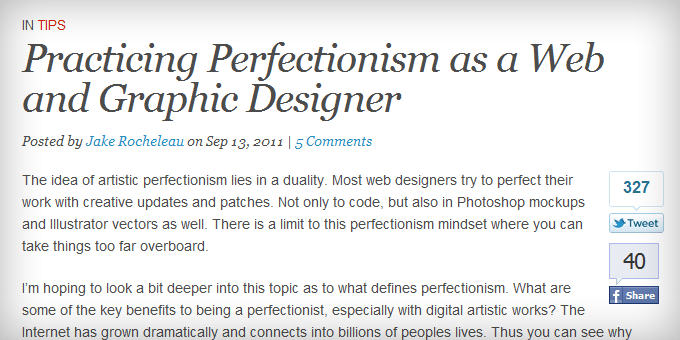
The web blog on the hand has only 3 which is more static; this is because some fonts that are used by the author may be readable to some readers as they do not have the software installed or the browser does not allow such fonts.
Referring to Nielson (1999), his comparison of the both is
Dimensionality. Print design has a 2-dimensional layout which brings out focus
to the readers. Readers can just flip
the page, however this has made the interaction between the spreads of another
page is hard to reach. In distinction, the web layout is a simultaneously
1-dimensional and N-dimensional layout. Instead of flipping through, web
proposes the scrolling experience for the user. N-dimensional is whereby the
web design coherently follows the hypertext navigation. An example below shows
the navigation of the cursor in web design which cannot be found in print
designs.
Navigation through blog interface websites

source: http://designgenies.com/blog/
Overall, I think it
is easier to read with print design due to less graphic structures which can be found
in the web design. According to Nielson (1999), he states that print design has
bigger impact to readers compared to web design due to its whole double paged
spread. Hence, reading with print design gives the readers more of an emotion
to readers. However, reading through the web maybe very informational but due
to its design, some images may cause a lag or unable to load the page which
will affect the reader to find another source of information.
References
Nielsen, J 1999, 'Print vs.web design' viewed 7 April 2012, < http://www.useit.com/alertbox/990124.html>.
Bear, J. H. n.d, 'Print Design vs. Web Design: Similarities
and Differences in Print and Web Design', The New York Times Company, New
York, viewed 8 April 2012, < http://desktoppub.about.com/od/transitionprintweb/tp/Print_Design_vs_Web_Design.htm>.
New Forms of Media Publishing
In the present day, technology has
played its part very well in developing social media as a medium to
communicate. This phenomenon has created a new drift that the public at large
has made social networking sites indispensible in their lifes. This is particularly the younger generation
which are familiar with Facebook, Twitter and Youtube. Consequently, this trend
has affected the traditional media publishing to cope with change of changing
from print media publishing to online publishing. As Naughton (2006) stated "there is declining newspaper
sales and the growth of online news; the expanding use of the web as a publication
medium by public authorities".

Figure 1: Diagram of the value of
social media
The trend has altered media
communication into a new media ecosystem. As seen in Figure 1, the value of
social media has many reasonable means for being the reason why traditional publishing is
decreasing day by day. Audiences now prefer going online because it is easily
accessible and its viability as a medium to publish news is tremendously
excellent in terms of timeliness, credible, and most importantly current up to
date.

source: http://www.insidefacebook.com/2009/07/07/abc-news-cnn-teaming-up-with-facebook-for-michael-jackson-memorial/
An example above is
the worldwide infamous producers of news; CNN has now collaborated with social
network champion, Facebook and made a "Live Stream" widget for the
community in Faceboo. It is to find ways to make live events more engaging and viral.
Hence,this is one of the steps by publishers are using to cope with the new media ecosystem (Smith, 2009).
References
Naughton, J 2006, 'Blogging and the emerging media', website viewed 6 April 2012, website retrieved from <http://reutersinstitute.politics.ox.ac.uk/fileadmin/documents/discussion/blogging.pdf>.
Smith, J 2009, 'Facebook Launches "Live Stream"
Widget for All publisher, Networks and Developers', website viewed 6 April
2012, website retrieved from <http://www.insidefacebook.com/2009/06/24/facebook-launches-live-stream-widget-for-all-publishers-networks-and-developers/>.
Subscribe to:
Posts (Atom)